
How Much Do Solar Panels Cost in the UK in 2026?
Fitted home solar panels cost about £4,995 to £7,600 in the UK in 2026: E.ON Next's 6-panel package to the Energy Saving Trust's typical 4.5kWp system.
I’m sure if you are considering installing solar panels, the most important questions on your mind are:
How much do solar panels cost, and how much profit and energy savings will I get?
Here you’ll find answers to all those questions, and more. If you just want a quick outline, here are the main points:
- Solar panels cost on average £7000 – £9200 for a 4kW system, which is enough for a 3-4 bedroom home.
- Solar savings can be increased by adding a battery storage system. Batteries like the Tesla Powerwall save power generated when grid prices are high, for evenings when most energy is used.
- Installing solar panels can give you a £745 per year profit for a 4kw system and can take an average of 9 years to break even.
Market Overview
The cost of solar panels has decreased by over 60% since the 1980s, and they now offer an attractive return on investment for homes and businesses in the UK, which we’ll go over in just a moment.
The whole United Kingdom has been expanding its solar power capacity at a fast rate over the last decade. This is reflected in the data published by the Department of Energy Security and Net Zero:
- Between January 2010 and July 2023, the UK expanded its residential solar capacity from 10.2 megawatts to 4,337.6 megawatts (MW).
- Considering solar projects of all sizes, including commercial and grid-scale systems, the UK expanded its capacity from 29.9 MW to 15,292.8 MW.
In other words, the UK increased its solar photovoltaic (PV) capacity by a factor of more than 500x in a 13-year period. To put these numbers into perspective, 1 megawatt of solar capacity can generate enough electricity for around 300 UK homes.
Compare My Solar Prices

Get quotes from local installers
1 fast form = 4 low quotes
Save up to £703 per year


Cost of Solar Panels for Different Household Sizes
| Type of Property | Solar Capacity Needed to Cover 100% of Consumption | Estimated Cost, Based on Financial Year 2022/23 Figures |
|---|---|---|
| 1 Bedroom Home | 2.0 – 2.4 kW | £4,730 – £5,676 |
| 2-3 Bedroom Home | 3.2 – 3.9 kW | £7,568 – £9,224 |
| 4-5 Bedroom Home | 4.8 – 5.7 kW | £10,080 – £11,970 |
Electricity consumption tends to increase along with the size of your home and the number of persons living with you. The Office of Gas and Electricity Markets (Ofgem) provides the typical electricity consumption in houses of different sizes:
| Type of Property | Annual Electricity Usage in the UK |
|---|---|
| Flat or single-bedroom home, with 1-2 people | 1,800 kWh |
| 2-3 bedroom home with 2-3 people | 2,900 kWh |
| 4+ bedroom home with 4-5 people | 4,300 kWh |
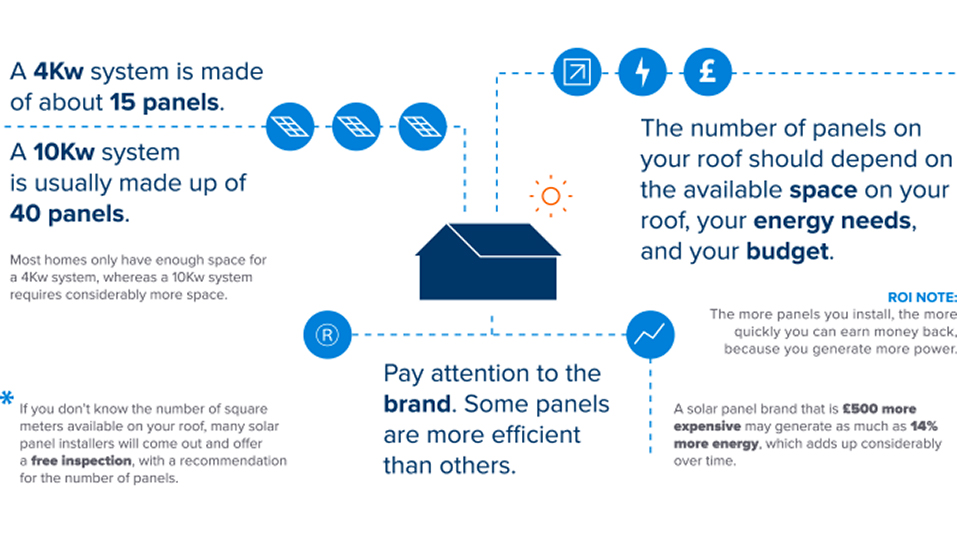
Based on these figures, we can estimate the solar PV capacity that would be needed to cover 100% of consumption in each case. Assuming you have a suitable site for solar panels, each kilowatt of installed capacity can offer you around 750-900 kWh/year. Here is an article that explains where this value comes from, and how to estimate the number of solar panels needed in a UK home:
Using this figure and values in the table above, we can estimate the solar system capacity that would be required for each home size. We can also estimate the price range in each case:
Here is the number of solar panels you would need to reach the required capacity in each case, assuming a rated power output of 400W per panel:
- Flat or single-bedroom home, with 1-2 people: 5 – 6 solar panels
- 2-3 bedroom home with 2-3 people: 8 – 10 solar panels
- 4+ bedroom home with 4-5 people: 12 – 15 solar panels
Consider that these calculations are broad estimates, based on industry data. A professional solar installation company can determine the optimal system capacity for your home, based on your monthly electricity consumption and roof geometry.
Solar Panel Costs Over Time
The Department of Energy Security and Net Zero is constantly gathering cost data from the UK solar industry. This data is published on their website and updated each month. The following table summarises the number of installations per year and their average cost per kilowatt, since the financial year 2013/14.
Solar Panel Installations with a Size Range of 4 kW
| Financial Year | Number of Solar PV Installations | Mean Cost per Kilowatt | Estimated Cost of a 4-kW Solar Power System |
|---|---|---|---|
| 2013/14 | 51,987 | £2,080 | £8,320 |
| 2014/15 | 69,460 | £2,070 | £8,280 |
| 2015/16 | 95,122 | £1,833 | £7,332 |
| 2016/17 | 21,987 | £1,866 | £7,464 |
| 2017/18 | 19,708 | £1,840 | £7,360 |
| 2018/19 | 32,370 | £1,816 | £7,264 |
| 2019/20 | 23,322 | £1,562 | £6,248 |
| 2020/21 | 28,638 | £1,628 | £6,512 |
| 2021/22 | 55,559 | £1,876 | £7,504 |
| 2022/23 | 115,648 | £2,365 | £9,460 |
Solar Panel Installations with a Size Range of 10 kW
| Fiscal Year | Number of Solar PV Installations | Mean Cost per Kilowatt | Estimated Cost of a 10-kW Solar Power System |
|---|---|---|---|
| 2013/14 | 2,041 | £1,640 | £16,400 |
| 2014/15 | 2,216 | £1,610 | £16,100 |
| 2015/16 | 3,694 | £1,460 | £14,600 |
| 2016/17 | 1,549 | £1,505 | £15,050 |
| 2017/18 | 1,985 | £1,509 | £15,090 |
| 2018/19 | 5,326 | £1,498 | £14,980 |
| 2019/20 | 2,413 | £1,704 | £17,040 |
| 2020/21 | 5,757 | £1,685 | £16,850 |
| 2021/22 | 10,591 | £1,605 | £16,050 |
| 2022/23 | 40,154 | £2,100 | £21,000 |
NOTE: The UK financial year starts on 6 April, which means the figures above are actually showing data from two years. For example, the financial year 2022/23 started on 6 April 2022 and ended on 5 April 2023.
The number of home solar systems in the UK increased drastically between 2021 and 2023. Rising energy costs are one of the main factors driving the adoption of distributed solar power. Between March 2022 and March 2023, domestic electricity prices increased by 57%.
Due to the high demand for solar panels, their price is also on the rise. Between financial years 2021/22 and 2022/23, their mean cost per kilowatt increased from £1,876 to £2,365 in small-scale systems (0-4 kW). However, this represents a 26% cost increase, much lower than the 57% increase in electricity prices. The demand for home solar installations in the UK has remained high even with rising costs.
The data in the tables also show that solar installations below 4 kW are much more popular than 4-10 kW systems. This can be explained by the fact that UK homes have a relatively low electricity consumption. For comparison, the average American home uses 10,632 kWh per year, while the average UK home only uses 2,900 kWh per year.
Does the UK Offer Incentives for Residential Solar Panels?
The UK has offered different types of incentives for solar panels throughout the year. Some programs such as the feed-in tariff are no longer available for new solar installations, but new incentives have been introduced. As of 2023, the UK offers two nationwide incentives for solar panels in residential applications:
- Value Added Tax (VAT) exemption for energy-saving materials, including solar panels.
- Smart Export Guarantee (SEG), which means you can sell excess generation from your solar panels to local energy companies.
VAT Exemption for Residential Solar Panels
The UK normally applies a 20% VAT for goods and services. Solar panels and other energy-saving products have been exempt from the VAT since 1 April 2022, and the benefit will remain available through 31 March 2027. After this date, solar panels will be subject to a 5% VAT but not the full rate of 20% applied to other products.
- Keep in mind that the VAT exemption only applies for England, Wales and Scotland.
- In Northern Ireland, the VAT for solar panels has been reduced to 5% but they are not completely exempt.
The VAT exemption is a major incentive for installing solar panels, since it represents immediate savings when you purchase the system. For example, if your solar installation has a price of £8,000, you are immediately saving a VAT of £1,600.
This incentive has a very important requirement. You only get the VAT exemption if you purchase solar panels as part of a complete system, installed by a qualified company. You are charged the normal VAT if you purchase solar panels by themselves from a retailer.
Smart Export Guarantee for Solar Panel Owners
The Smart Export Guarantee (SEG) was introduced in January 2020 as a way to compensate solar panel owners for excess generation.
- In simple words: if your solar panels generate more electricity than what your home is using at a given time, you can sell surplus production to local energy companies.
- This tends to happen around noon, when solar panels reach maximum productivity, which is exactly when many homes are empty.
Thanks to the SEG, you can send excess solar energy to the grid in exchange for power bill credits. For example, if your solar PV system generates 10 kWh on a day when your house uses 5 kWh, you can sell the remaining 5 kWh through the National Grid.
There are many electricity providers who participate in the SEG, and you have the flexibility to choose separate companies for your electricity consumption and solar energy exports.
- Participation in the SEG is mandatory for electricity providers with at least 150,000 domestic customers, but optional for providers with a smaller customer base.
- The Ofgem website has an updated list of SEG suppliers.
The SEG tariffs for surplus solar energy have a very broad range: some companies only pay 1 p/kWh, while others pay nearly 30 p/kWh. However, you can only access the highest compensation rates if the company purchasing your surplus solar energy is also your provider. When choosing different companies for your electricity supply and solar exports, SEG tariffs are normally below 12 cents/kWh.
What Is the Payback Period of a Solar Panel System?
The payback period of solar panels in the UK can vary depending on how their electricity output is divided between self-consumption and grid exports through the SEG.
- When you consume one kWh of solar electricity, you save its full value.
- When you export one kWh to the grid, you get an SEG tariff which is normally lower.
For a homeowner who normally pays 35 p/kWh, a solar panel output of 3,000 kWh/year would save £1,050 if used completely. However, if you export all this electricity to the grid at a buyback tariff of 6 p/kWh, you only get £180.
The following table provides the estimated payback period of a 4-kW solar panel system under different combinations of self-consumption and grid export. The system has a cost of £8,400 and its electricity output is 3,500 kWh per year. The calculations assume an electricity price of 35 p/kWh and a solar export tariff of 12 p/kWh:
| Scenario | Annual Savings | Payback Period |
|---|---|---|
| 30% Consumption, 70% Grid Export | £661.50 | 12.7 years |
| 50% Consumption, 50% Grid Export | £822.50 | 10.2 years |
| 70% Consumption, 30% Grid Export | £983.50 | 8.5 years |
The payback period of solar panels is shorter for homeowners who consume a large fraction of the electricity generated. On the other hand, the payback period is extended if most of your solar generation is exported to the grid.
The best solar panels normally come with a warranty period of 25 years or more. In the three scenarios considered above, the solar PV system recovers its upfront cost eventually thanks to its long service life.
Solar Cashback Programs from Local Banks
Depending on your bank, you may be able to get a cashback when installing a solar panel system in the UK. The following are some banks who offer solar incentives for customers who currently have a mortgage with them (as of September 2023):
- Barclays Greener Home Reward: £1,000 for mortgage customers who install solar panels. The photovoltaic system must be installed by a TrustMark-registered business or tradesperson. This benefit will remain available until 31 January 2024.
- Lloyds Bank Eco Home Reward: £500 for mortgage customers who install solar panels. This benefit will remain available until 31 October 2023.
- Halifax Green Living Reward: £500 for mortgage customers who install solar panels. This benefit will remain available until 31 October 2023.
If you currently have a mortgage with one of these banks and you are considering solar panels, their cashback programs can reduce the net cost of your project.
ECO4 Scheme: Free Solar Panels for Low Income Households
The UK government has the Energy Company Obligation (ECO4) scheme, which has the goal of reducing fuel poverty and carbon emissions. The number four indicates that the scheme is currently in its fourth iteration – the ECO3 scheme ended on 31 March 2022 and ECO4 will end on 31 December 2026.
The ECO4 scheme offers free solar panels (subject to approval), but they are only available for low-income households who are currently receiving at least one of the following benefits:
- Child Benefit
- Pension Guarantee Credit
- Income-related Employment and Support Allowance (ESA)
- Income-based Jobseeker’s Allowance (JSA)
- Income Support
- Tax Credits (Child Tax Credits and Working Tax Credits)
- Universal Credit
- Housing benefit
- Pension credit saving credit
Households with an income below £31,000 may qualify for additional incentives through the ECO4 Plus scheme.
How Long do Solar Panels Take To Install?
| Survey to provide firm quote | 1-2 hours |
| Inspection of electrics and taking final measurements | 1-3 hours |
| Scaffolding erected to gain safe access to the roof | 4-5 hours |
| Installing the panels | 4-5 hours |
| Installation of electronics | 3-6 hours |
| Tidying up and removal of scaffolding | 3 hours |
| Total | 16 – 24 hours |
How much do solar panels typically cost in the UK?
Solar panel systems in the UK cost between £4,000 to £7,000 for an average-sized household.
Are there ongoing costs after installing solar panels?
After installation, maintenance costs are low, typically involving occasional cleaning and periodic inspections.
Does the UK government offer subsidies for solar panel installation?
Schemes like the Smart Export Guarantee can offset installation costs.
Can I save money by installing solar panels?
Yes, solar panels reduce your electricity bill and can earn money through energy exported to the grid.
How does solar panel financing work in the UK?
Various financing options are available, including green loans, personal loans, and solar leasing agreements.
Now read:
Written By

Reviewed By
