
What Is Net Metering? Complete Guide for UK Solar Panel Owners
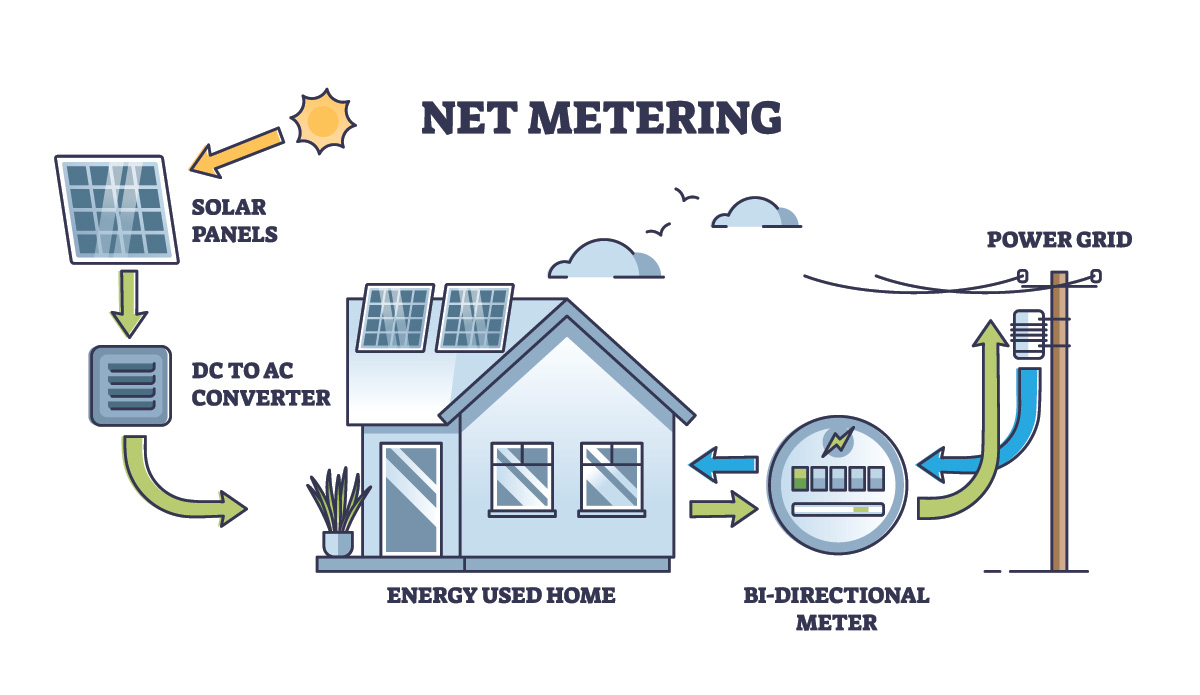
Solar panels often generate excess electricity that cannot be consumed by your home right away. When this happens, you are missing out on potential savings.
There are two main ways to manage surplus energy production from photovoltaic (PV) panels:
- Net metering: Sending unused energy to the National Grid in exchange for power bill credits. In other words, a local electricity provider buys your excess production.
- Energy storage: Using a solar battery to store excess energy and use it later. This option requires the installation of a battery bank.
Governments and energy companies use different names for net metering programs around the world. In the UK, there have been two schemes that can be considered forms of net metering:
- Smart Export Guarantee (SEG) Scheme, introduced on 1 January 2020.
- Feed-In Tariff (FIT) Scheme, closed to new applicants since 1 April 2019.
In this article, we will discuss the UK net metering program and how it benefits homeowners who install solar panels.
What you’ll find here
How Does Net Metering Work?
To offer net metering, the local power company must be capable of measuring electricity flows in two directions: from the grid to your home and vice versa. There are two main ways to accomplish this:
- Using modern bidirectional power meters: They can detect if your property is consuming or supplying electric power. At the end of each billing period, the credits for excess solar production are subtracted from your consumption.
- Net metering is also possible with two traditional power meters: The first one measures your consumption, while the second measures only your solar generation. This configuration was more common in the early days of the solar industry, before the widespread adoption of bidirectional power meters.
Under the Smart Export Guarantee (SEG), you can sell excess solar energy to one of the electricity providers operating in the UK. The export tariff per kilowatt-hour (kWh) varies depending on the company you choose to purchase your energy.
- You can choose one energy company to supply electricity, and another to purchase your excess solar energy. You are not forced to pick the same company for both roles.
- However, many energy companies offer much higher export tariffs if you also choose them as your electricity provider.
For example, if you have an SEG tariff of 6 p/kWh and you export 2,000 kWh of unused solar energy during the year, you get £120 in addition to your normal savings. If you qualify for a higher export tariff of 15 p/kWh, you get £300 for the same amount of solar energy.
The SEG is available for solar energy systems with a size of up to 5,000 kW. This is not an issue for homeowners, since the typical residential system has a size of around 4 kW.
- The SEG covers England, Scotland and Wales.
- The SEG does not cover Northern Ireland. However, you can sell excess solar energy to an electric company called Power NI, or a charity called Action Renewables. Both of them offer solar buyback rates that can be compared with the best SEG tariffs.
Compare My Solar Prices

Get quotes from local installers
1 fast form = 4 low quotes
Save up to £703 per year


How Does the SEG Reduce the Payback Period?
Without a net metering scheme, you only save the value of solar electricity that is used directly. For example, if a 4-kW solar system can generate 3,600 kWh/year but you only use 2,000 kWh, you are wasting the value of 1,600 kWh.
The Smart Export Guarantee (SEG) makes sure you can sell unused solar energy to local electricity providers. Using the same example of a system generating 3,600 kWh/year, you can use 2,000 kWh directly and sell 1,600 kWh.
Assume you are currently paying an electric tariff of 35 p/kWh, and you are selling unused solar energy at an SEG tariff of 12 p/kWh. Here is a comparison of the annual savings achieved with and without the SEG:
| Scenario | Direct Savings by Using Solar Energy (2,000 kWh) | Additional Value of Unused Electricity (1,600 kWh) |
|---|---|---|
| 1) Only solar energy savings | £700 | £0 |
| 2) Solar energy savings and SEG tariff | £700 | £192 |
As of 2023, a 4-kW solar system has a typical price of £8,400 in the UK.
- Considering only £700 in solar energy savings, the payback period is 12 years.
- Adding £192 in SEG exports, the total savings increase to £892/year and the payback period is shortened to 9.4 years.
IMPORTANT NOTE: This is a simplified example. A professional solar installer can determine the exact savings you can expect in your house, based on energy consumption habits.
Having access to SEG tariffs is helpful, but relying too much on solar energy exports instead of direct consumption is not recommended either. If you end up exporting most of your solar generation at reduced tariffs, you can consider using a battery bank to store energy. This way you save the full value of the electricity stored, instead of exporting it at reduced tariffs.
Managing Excess Solar Energy: Should I Use Battery Storage or an SEG Tariff?
As previously mentioned, there are two main ways to manage excess production from your solar panel system:
- Choosing an SEG tariff and selling your extra kilowatt-hours.
- Installing a battery and storing excess energy to be used at night.
Like in many other technical decisions, each option has pros and cons:
| Options | Pros | Cons |
|---|---|---|
| 1) SEG tariff | You only need to choose an SEG tariff, without investing in additional equipment. | You only save a fraction of the value of each kWh. SEG export tariffs are much lower than the retail tariffs you pay. |
| 2) Battery storage | If you store excess energy to be used later, you save the full value of each kWh. | Energy storage systems are expensive: a 10-kWh battery can cost more than £9,000. |
Keep in mind that you can use both options – they are not mutually exclusive. For example, if you have a 10-kWh battery and your solar panels generate 12 kWh of excess energy per day, you can store 10 kWh and export 2 kWh.
Installing a home battery along with your solar panels makes sense financially under the following conditions:
- When your home has low energy consumption during the day, and you end up exporting most of the electricity generated by solar panels.
- When you don’t have access to favourable SEG tariffs from local electricity companies. For example, some companies pay tariffs as low as 1-3 p/kWh, while charging more than 30p/kWh.
Here is an example, showing a scenario where relying too much on the SEG tariff is not a good option. In this case, installing a solar battery is a viable option:
- Assume you are generating 4,500 kWh/year with a 5-kW solar system, but you only use 1,000 kWh directly while exporting 3,500 kWh.
- Also assume you don’t have access to high SEG tariffs, and you only get 3 p/kWh while paying a retail tariff of 35 p/kWh.
At a price of 35 p/kWh, you save £350/year by using 1,000 kWh of solar electricity. However, you only get £105 for the 3,500 kWh sent to the National Grid. Since you are exporting 78% of your solar production and getting a low SEG tariff, you only save £455/year. Considering that a 5-kW solar system costs around £10,500, the payback period in this example is 23 years.
If you invest £9,500 in a home battery, you can store excess solar energy instead of sending it to the grid. In this case you save the full value of 4,500 kWh, which is equivalent to £1,575. The project cost increases to £20,000, but its payback period is reduced to 12.7 years.
On the other hand, a homeowner with a higher SEG tariff and a higher percentage of solar energy consumption might not benefit much from a battery bank. Consider another example:
- You are consuming 3,500 kWh and exporting only 1,000 kWh.
- You get an SEG tariff of 12 p/kWh.
In this case, the energy savings without a battery add up to £1,345/year and the payback period is 7.8 years. You could save £1,575 with a battery bank, but the payback period would extend to 12.7 years.
NOTE: This article uses simplified examples to demonstrate how SEG tariffs and battery storage can influence your solar energy savings. If you are considering solar panels for an actual property, the best recommendation is getting a professional energy assessment.
What Solar Export Tariffs Are Available in the UK?
All UK electricity providers with at least 150,000 domestic customers are required to participate in the Smart Export Guarantee. This means they must offer grid export tariffs for homeowners with solar panels. Here are some of the highest SEG tariffs you can find as of November 2023, but take note that the list is constantly changing:
| Electricity Provider | Tariff Name | SEG Rate | Special Conditions |
|---|---|---|---|
| Octopus Energy | Outgoing Fixed | 15 p/kWh | Only available for Octopus Energy customers. |
| Octopus Energy | Octopus Flux | 5-29 p/kWh, variable rate | Time-of-use tariff, export rate varies depending on the hour. Only available for Octopus Energy customers. |
| Octopus Energy | SEG Tariff | 4.1 p/kWh | Available for all eligible users. |
| Scottish Power | SmartGen | 12 p/kWh | Available for all eligible users. |
| Scottish Power | SmartGen+ | 15 p/kWh | Only available if you purchase your solar panels from Scottish Power |
| Good Energy | Solar Savings | 15 p/kWh | Only available for Good Energy customers. |
| SO Energy | SO Export Flex | 7.5 p/kWh | Available for all eligible users. |
| British Gas | Export and Earn Plus | 15 p/kWh | Only available for British Gas customers. |
| British Gas | Export and Earn Flex | 6.4 p/kWh | Available for all eligible users. |
| OVO Energy | OVO SEG Tariff | 4 p/kWh | Available for all eligible users. |
As you can see in the table above, you can get much better SEG tariffs if you choose the same electric company as your provider and your solar energy buyer.
The highest tariff that does not require you to be a customer is offered by Scottish Power (12 p), but their service territory is limited. SO Energy (7.5 p) and British Gas (6.4 p) are also good options if you look for an SEG tariff that does not require you to be a customer.
Written By

Reviewed By
