
Window Furniture: All You Need To Know in 2026
Among the top considerations in window construction and improvement is ensuring that your investment will be worth the convenience, comfort, and overall satisfaction that your windows will ultimately provide. As a property owner, it is important to recognize that choosing the appropriate furniture for the type of window that you have is a crucial step in helping you achieve this goal.
Fortunately, you no longer need to scour the internet for the right information. In this detailed guide, Ecopreneurist has already rounded up the different hardware and accessories that you can try so you can maximize your windows’ technical efficiency and functionality.

Article Highlights
• Window furniture includes handles, locks, hinges, stays, and other accessories that contribute to the window’s operation and appearance.
• This article presents 10 types of window handles, 2 locking mechanisms, 11 variations of locks, and 6 different hinges.
• Window stays and window restrictors may have similar functions but they serve different purposes.
• Several kinds of window furniture are currently available on the market. It is vital to know the types of windows that they are compatible with to make informed buying decisions.

Compare Window Prices

Get quotes from local installers
1 fast form = 4 low quotes
Save up to £703 per year


What you’ll see here:
Definition of Terms
You might be asking, how is window furniture different from window fittings and accessories? Well, these terms are sometimes used interchangeably but here is how they are generally defined:
• Window furniture –
functional and decorative hardware components attached to windows. Examples are handles, locks, hinges, stays, and other accessories that contribute to the window’s operation and appearance.
• Window fittings –
is a broader category that refers to materials or components installed to improve the performance of windows. This may include both hardware and non-hardware items like frames, grilles, bars, gaskets, seals, and insulation materials.
• Window accessories –
additional items that can be used to elevate windows for decorative or practical purposes. They include but are not limited to curtains, blinds, shutters, and window film.
Do note that while it is important to be able to tell these terms apart, their actual usage may still vary among professionals in the construction and design industries.
Window Handles
A window handle is a material attached to a window that aids in its opening and closing mechanism. Below are the standard handles used for specific window types.
Casement Window Handles
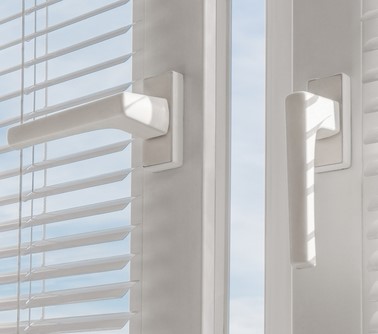 Inline handle A universal handle that needs to be turned left or right to open the window. |  Offset handle Designed with an offset or angled position for windows with spatial constraints. | 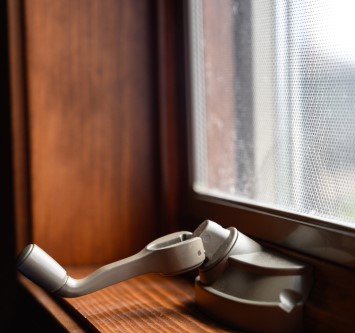 Crank handle May be cranked clockwise or counterclockwise to swing the window open or closed. |
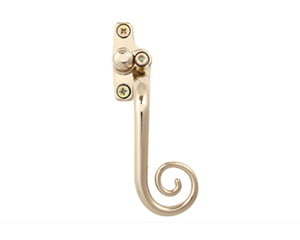 Monkey tail handle A traditional curvy and twisted design like this one from leading window supplier, Everest. |  T bar handle This handle from Izé has a simple T shaped design and is used in a push and pull manner. | 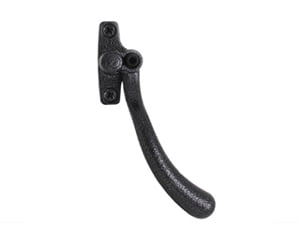 Tear drop handle Has a distinct tear shaped or droplet shaped design. This one is also from Everest. |
Sash Window Handles, Lifts, Rings, and Lifts
There are several choices of handles for sash windows which can be used to slide the bottom sash upward when opening a window or vice versa. Here are a few examples from Ironmongery Direct‘s antique brass collection:
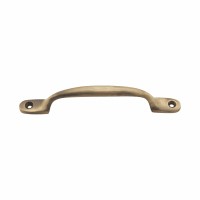 Sash pull handle | 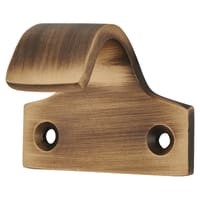 Sash lift | 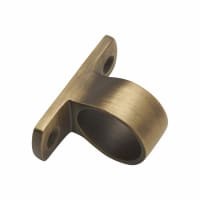 Sash ring |
Tilt and Turn Window Handles
Like in casement windows, inline and crank handles may also be used to open and close tilt and turn windows.

Inline tilt and turn handle
Window Handles Based on Locking Mechanisms
| Espagnolette handle Handles that use the Espagnolette locking system, where a flat metal strip runs up the locking side of a window and moves when the handle is turned. This locking system can be used in inline, offset, crank, monkey tail, and tear drop handles (e.g. inline espag window handle). | 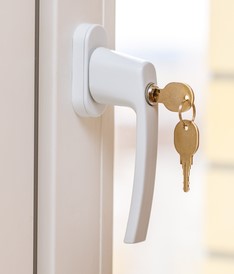 |
| Cockspur handle Handles that have a latch and catch locking system. They involve a cockspur handle where the “latch” is located and a “catch” where the latch stays if the windows are closed. This locking cockspur handle on the right can be found on handlestore.com. |  |
Window Locks
Locks provide security, safety, and privacy to property owners. The following are some of the common locks available on the market and their window compatibility.
| Locks | Description | Compatible Window Types |
|---|---|---|
| Keyed Lock | Requires a key to open or close the window. The key has a unique configuration of notches that match the lock’s internal components to engage and disengage the locking mechanism. | casement, sash, tilt and turn, and sliding |
| Pin lock | Also referred to as chain locks for windows. One part is attached to the pane while the other is fixed on the frame. The two parts are connected by a chain that prevents the window from opening wider, allowing secure visibility when needed. | casement, sash, and sliding |
| Latch | Connects two sashes to prevent them from moving. This is not a robust window lock and must be installed with other types of locks. | single and double hung sash |
| Window fastener | Comprised of a lever that works as a latch and a catch fixed to the window frame. It is essentially a locking hardware with a handle. | casement and sash |
| Folding lock | Window locks that fold down to keep the panes locked and fold up to release the lock. | casement |
| Hinged wedge | Secures and prevents the movements of window panes. Typically used as an additional measure to complement existing locks. | sash and sliding |
| Bolt lock | Consists of a bolt that extends from the window frame to another fixed part when engaged. | casement, sliding, and sash |
| Cam lock | Has a rotating cam that engages with a keeper in the window frame to secure a window in the closed position. | sash and tilt and turn |
| Swivel action lock | Feature a self-locking catch that prevents a closed window from opening. To disengage, the catch is turned to the right. This type of lock does not require a key. | double hung sash |
| Sliding window lock | Placed in the track of the sliding window to prevent it from opening and may come in the form of a lever or a thumbscrew. | sliding |
| Smart lock | Next-generation electronic lock that uses a code instead of a key. The owner can also access the window using devices like a smartphone. | casement, sash, tilt and turn, and sliding |
Window Hinges
Hinges are major components in various types of windows. These mechanical devices provide support and facilitate the controlled movement of window panes.
| Butt hinges | Traditional hinges consisting of two rectangular plates joined by a pin. One plate is attached to the sash and one is attached to the frame, allowing the window to open and close. |
| Friction hinges | Use a friction mechanism to keep the window open at a desired angle. |
| Pivot hinges | Enable windows to pivot around a central point. Commonly used in pivot windows. |
| Crank hinges | Use a crank mechanism to open the window and is often paired with a crank operator or handle. |
| Stormproof hinges | Have a deeper offset than standard hinges allowing the window to be sealed more tightly against the frame. Typically made of durable materials. |
| Piano Hinges | Also known as continuous hinges, they run the entire length of the window sash. Commonly for heavy-duty, commercial applications. |
Window Stays and Restrictors
These two window furniture are often confused with one another since they seem to serve the same purpose. However, as far as technicality goes, here is how they are different.
| Features | Window Stay | Window Restrictor |
|---|---|---|
| Purpose | Hold opened windows at a particular angle while providing support to prevent it from closing. | Safety device that limits the degree of opening of windows for safety, security, or compliance with building regulations. |
| Function | Offer adjustable ventilation and added security. | Since it prevents the windows from opening past a certain point, it is particularly useful as a security measure. |
| Variations | casement stays, fanlight stays, telescopic stays, axial stays, sliding stays, friction stays, and folding stays | casement window restrictors, friction stay restrictors, cable restrictors, sash window restrictors, child safety restrictors, and lockable restrictors |
| Examples from ERA Everywhere | 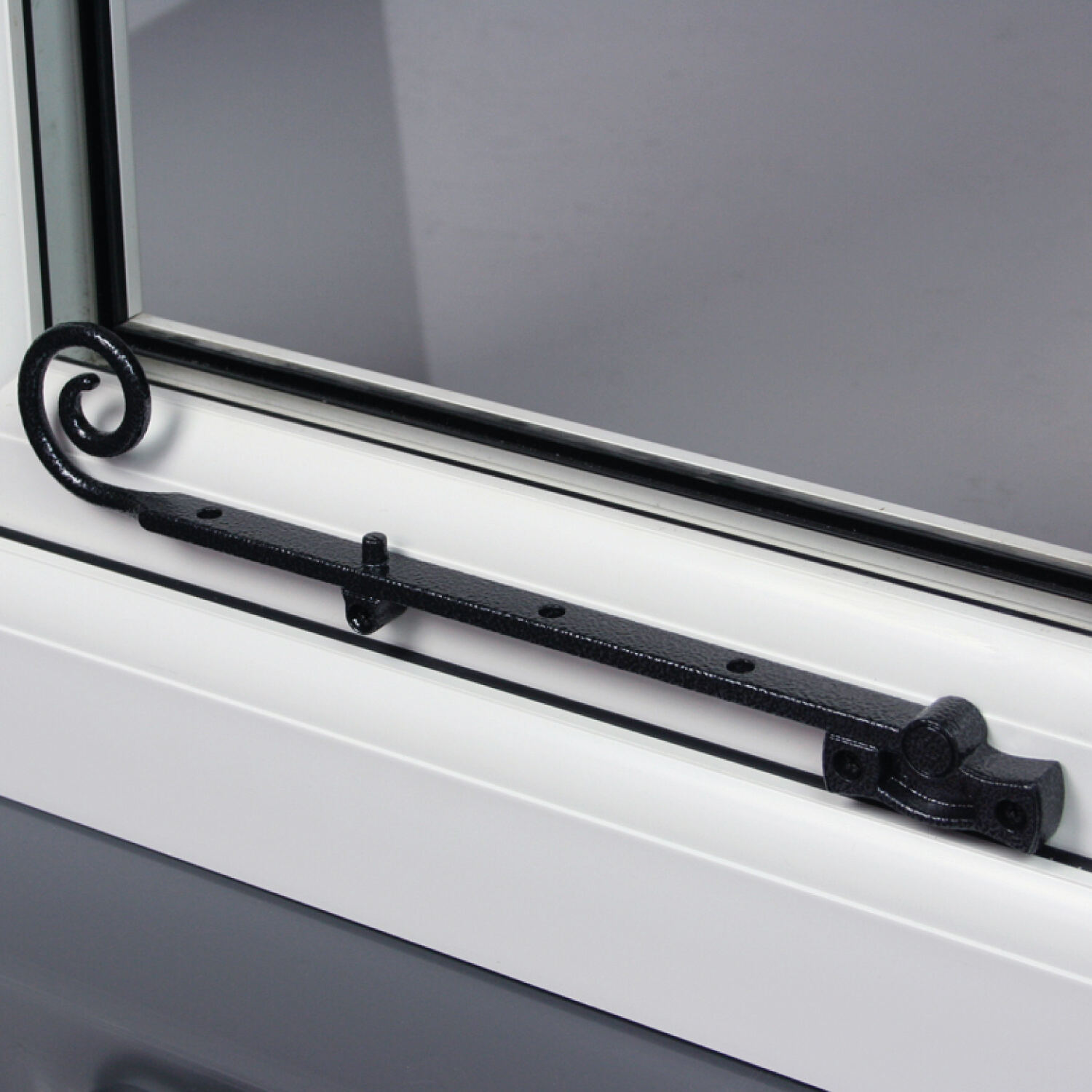 Monkey tail casement stay |  Cable restrictor |
Choosing the Right Furniture for Your Windows
It is highly essential to make informed choices when shopping for your window furniture. As an initial step, familiarize the type of window that you have and the kinds of furniture best suited for it. Not only will you save time in the process but also money since you can now stick to buying only what you need.
There is a varied selection of window furniture available on the market so you might want to consider matching their finish or style to your property’s interior design. In addition, the diversification of furniture options also offers you more leverage to fit purchases within your targeted budget.
Finally, several window furniture provide extra security for you and your property. Evaluate which features will cater to your specific priorities, may it be protecting your children, deterring burglars, withstanding harsh weather conditions, and others.
What are the different types of window furniture?
Handles, locks, hinges, stays, restrictors, and other accessories that contribute to the window’s functionality and appearance.
What is a window stay?
A device that holds opened windows at a particular angle, providing support and preventing it from closing.
What is a window restrictor?
A device that limits the degree of opening of windows for safety, security, or compliance with building regulations. Restrictors prevent windows from opening beyond a desired point.
How often should I maintain my window furniture?
It is recommended to clean your window furniture every 3 to 6 months. If you want to be time efficient, you may also clean them as often as you do your window frames. Note that specific furniture such as hinges require oiling as well.
What is an espagnolette or espag handle?
Espagnolette handles are named after the locking mechanism that they use, the Espagnolette locking system. The system consists of a gearbox and locking points called mushroom bolts. To open the window, the handle must be turned or unlocked to disengage the mushroom bolts.
The term “espagnolette” is derived from the French word “espagnol”, meaning Spanish, owing to the invention being historically associated with Spanish architecture.
Now read:


Written By

Reviewed By
